


Conflict Resolution Using the DISC Model

Workplace conflicts often look like “personality clashes,” but in reality, they are usually mismatches in communication style and expectations.
The DISC model - Dominance (D), Influence (I), Steadiness (S), and Conscientiousness (C) - helps you decode these patterns and turn tension into collaboration.
What conflict really is in DISC terms
At its core, conflict is usually about unmet needs:
D types want control, speed, and results.
I types crave recognition, fun, and connection.
S types seek stability, harmony, and time.
C types need accuracy, structure, and logic.
When one person’s style overrides another’s needs - such as a D pushing fast decisions when an S needs time to process - tension builds. DISC helps you see conflict not as “who’s wrong,” but “whose needs are not being met.”
Step 1: Diagnose styles, not blame
Before trying to “fix” a conflict, map the DISC styles of the people involved.
Ask:
Who is more direct and outcome‑driven? (D)
Who is more expressive and relationship‑focused? (I)
Who is patient, supportive, and conflict‑avoidant? (S)
Who is detail‑oriented, analytical, and cautious? (C)
This diagnosis helps you:
Anticipate triggers: For example, Ds may feel slowed down by Cs and Is may feel ignored by S‑style silence.
Shift the conversation from “you’re difficult” to “your style and theirs need to be bridged.”
Step 2: Match your approach to each style
An effective conflict resolution conversation speaks to each person’s DISC preferences.
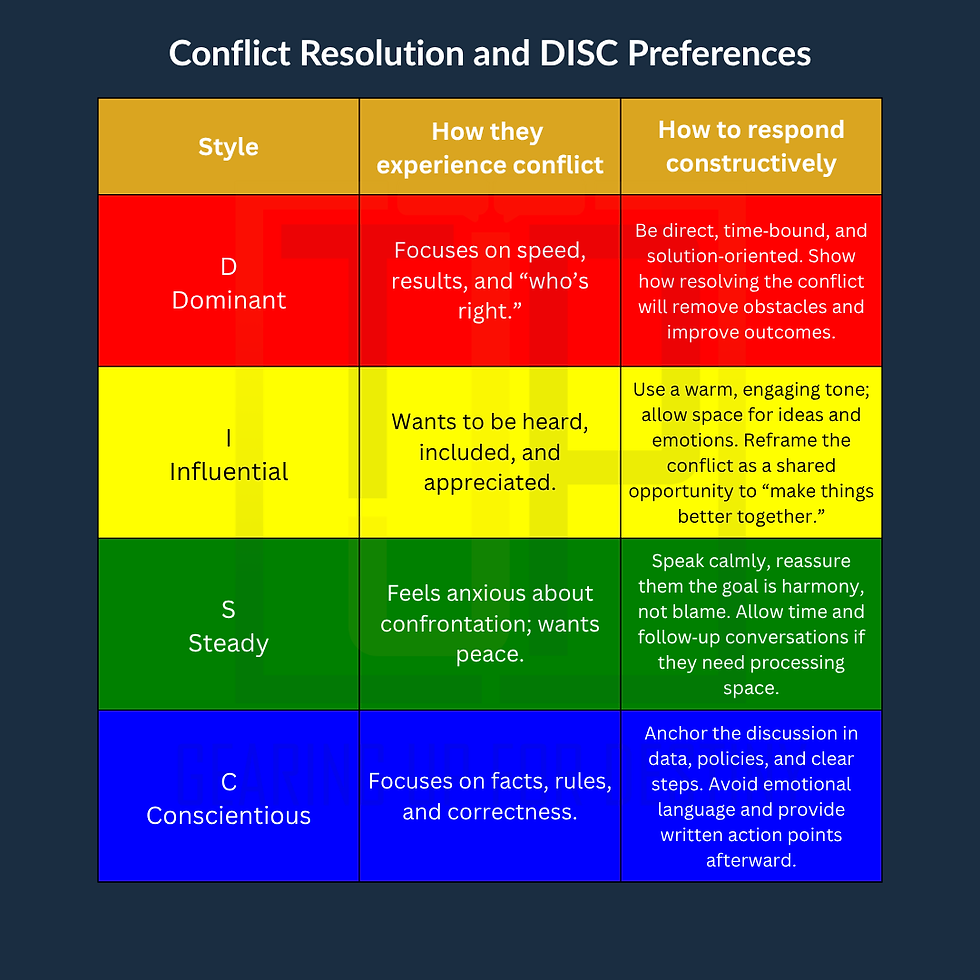
Tailoring your language and process to each style reduces defensiveness and increases buy‑in.
Step 3: Guide the conversation from “positions” to “interests”
A powerful DISC‑based move is to shift people from their positions (“This is what I want”) to their underlying interests (“This is why I need it”).
For example:
A D might say, “We must move fast,” whose interest is control, efficiency, and impact.
A C might say, “Slow down,” whose interest is accuracy and risk reduction.
As a team lead or a team member, you can ask:
“What are you worried will happen if we don’t resolve this?” (uncovers S/C fears).
“What would a ‘win’ look like for you?” (clarifies D/I goals).
This reframing helps you design solutions that respect different styles while still achieving shared goals.
Step 4: Craft win‑win solutions using DISC strengths
Once you understand each person’s needs, design a solution that leverages DISC strengths instead of treating style differences as problems.
For example:
Pair a D’s decisiveness with a C’s attention to detail so decisions are both fast and well‑grounded.
Let an I bring energy and ideas, while an S ensures the team feels supported and respected.
Group problem‑solving techniques that work well with DISC include:
Brainstorming with I and D leading ideas, then S and C refining and executing.
Using “role‑reversal” exercises where each person explains the conflict from the other’s DISC perspective. This builds empathy and turns conflict into a learning opportunity.
Step 5: Close with clarity and follow‑up
A DISC‑informed conflict resolution ends with a clear agreement that respects each style.

For Ds: Emphasise concrete outcomes, timelines, and ownership.
For Is: Emphasise recognition, celebration of progress, and informal check‑ins.
For Cs: Emphasise milestones and how progress will be reviewed.
For Ss: Offer reassurance and opportunities to check‑in if they feel uneasy.
Document the agreement in a simple format, who does what, by when, and who checks in, and revisit it after a short period to reinforce trust and accountability.
Here's a summary of the steps:
Step 1: Diagnose styles, not blame
Step 2: Match your approach to each style
Step 3: Guide the conversation from “positions” to “interests”
Step 4: Craft win‑win solutions using DISC strengths
Step 5: Close with clarity and follow‑up


Comments